Date Posted: 04.22.2026
Seattle Public Utilities is a national leader in rethinking how cities manage stormwater, shifting from conventional “gray” infrastructure — pipes, tanks and treatment plants — to a more adaptive, ecological approach known as green stormwater infrastructure (GSI). In 2013, the city set an ambitious goal: to manage 700 million gallons of stormwater annually using nature-based systems by 2025. Achieving this milestone has required not only policy innovation and interdepartmental coordination, but also deep collaboration with design leaders. Among those, Mithun has played a significant and sustained role in shaping Seattle’s green infrastructure transformation.
GSI mimics natural hydrological processes. The hard surfaces of buildings and parking lots rapidly channel rainwater away, creating erosion and carrying oil, grease and tire dust from roads into surrounding waterways. GSI captures, slows, infiltrates and cleans runoff close to where it falls, through systems such as rain gardens, bioswales, permeable pavements, green roofs and urban forests, stormwater. This approach has multiple benefits: it reduces pollution entering waterways, mitigates flooding, replenishes groundwater, reduces temperatures and creates enjoyable places to be in the city. Seattle’s success in scaling these systems to collectively manage hundreds of millions of gallons annually reflects more than technical achievement — it is a cultural and institutional shift toward working with nature.
Twenty-five years ago, Seattle became the first U.S. city to implement a successful GSI project in the public right-of-way through its SEA (Street Edge Alternative) Streets initiative. That early experiment demonstrated that streets themselves could function as ecological systems. Since then, the city has expanded its efforts through programs such as Broadview and Pinehurst Green Grids, the redevelopment of the High Point neighborhood, the RainWise Program, Swale on Yale and the Seattle Green Factor. These initiatives have collectively built a robust framework for integrating green infrastructure into neighborhoods, streetscapes and private development.
Mithun’s role in this evolution has been multifaceted, spanning design innovation, policy testing, community engagement and long-term collaboration with public agencies, institutions, private developers and community organizations. As an early adopter of Seattle’s green infrastructure ethos, Mithun helped test and refine the Seattle Green Factor, a code requirement for new development to incorporate vegetation and landscape strategies. Mithun works on five to ten projects annually within Seattle that must meet these standards, directly contributing to embedding GSI into the fabric of the everyday experience of people.
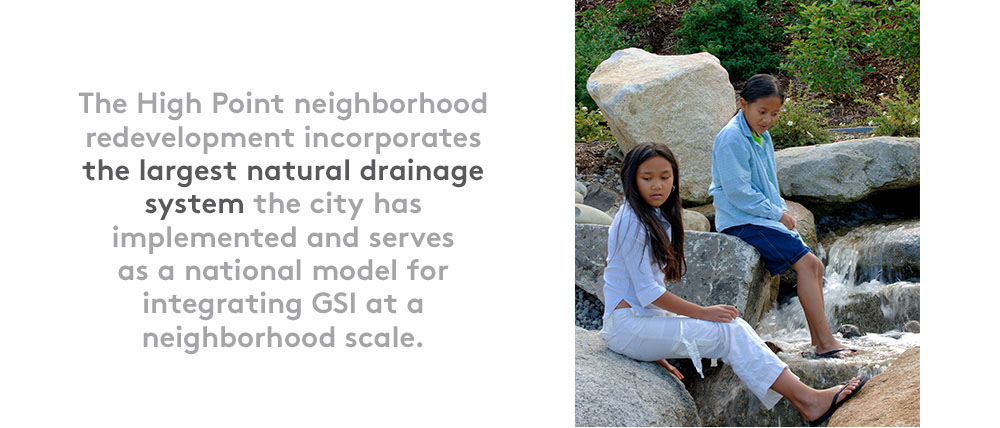
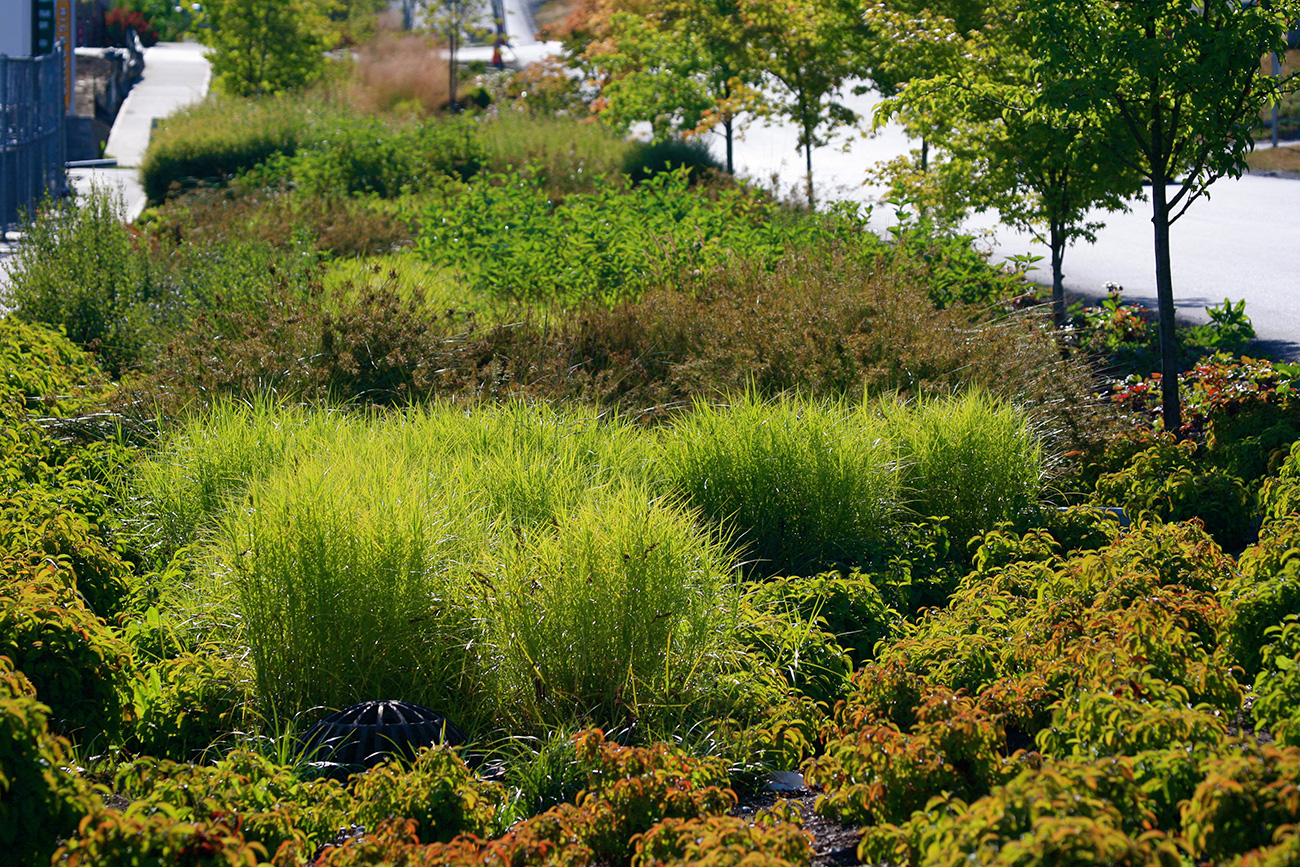
One of the firm’s most influential contributions can be seen in the High Point Natural Drainage System in West Seattle. This project represents the largest natural drainage system the city has implemented and serves as a national model for integrating GSI at a neighborhood scale. Designed in partnership with the Seattle Housing Authority and Seattle Public Utilities, High Point treats approximately 10 percent of the watershed feeding Longfellow Creek. The system uses swales, landscaped ponds and wetlands to replicate the function of a forest meadow — capturing and filtering stormwater while creating accessible green space for residents. The preservation of existing trees, the natural drainage system and parks at High Point creates such a pleasant neighborhood that people from the surrounding area enjoy coming there to walk, recreate and linger.
Completed in phases between 2005 and 2009, High Point demonstrates that dense urban environments can support large-scale ecological infrastructure. High Point was recognized with the Urban Land Institute’s Global Award for Excellence in 2007 which highlighted the integration of green infrastructure, sustainable design with mixed income housing and the physical and mental health benefits for residents.
Mithun’s work extends beyond single projects to broader systems thinking. Through collaborations with Seattle Public Utilities, the firm has contributed to green stormwater planning efforts, floodplain reconnection strategies and watershed-scale interventions. In south Delridge, for example, Mithun has been involved in designing floodplain reconnection projects along Longfellow Creek. These efforts aim to restore natural hydrology while addressing urban flooding, combined sewer overflows and ecological degradation. By integrating trails, boardwalks and public spaces into these landscapes, the projects also strengthen community connections to nature — an essential component of long-term stewardship.
Another key dimension of Mithun’s contribution lies in advancing hybrid infrastructure solutions that combine engineered systems with natural processes. The Taylor 28 project in South Lake Union neighborhood illustrates this approach. There, Mithun designed a streetscape that transforms excess roadway into pedestrian-oriented green space while incorporating rain gardens, permeable pavement and a hybrid cistern system. The cistern captures roof runoff for irrigation and non-potable uses, reducing demand on municipal water supplies while preventing stormwater from entering the combined sewer system. The project achieves zero runoff discharge for storms up to a 25-year event, demonstrating how integrated design can meet both regulatory requirements and environmental goals.
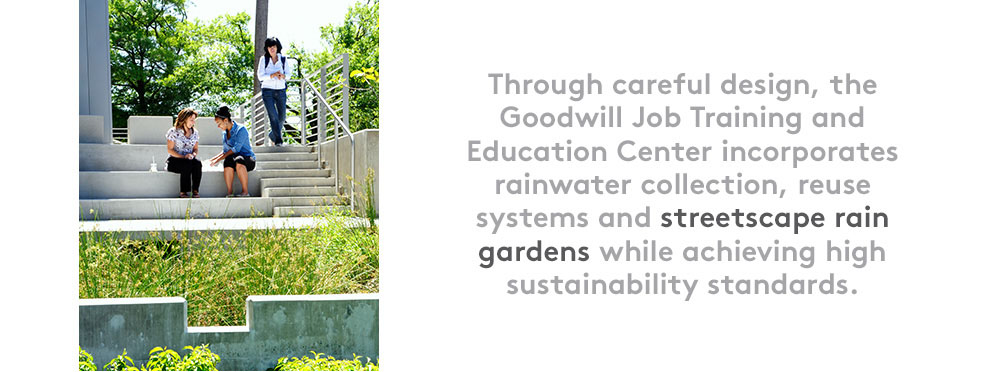
Raingardens that receive water from the roof and the road create a peaceful respite for people in a busy spot in the city. Similarly, the Goodwill Job Training and Education Center showcases how GSI can be implemented within tight urban sites and constrained budgets. Through careful design, the project incorporates rainwater collection, reuse systems and streetscape rain gardens while achieving high sustainability standards. These types of projects are critical because they prove that green infrastructure is not limited to large-scale developments; it can be adapted to a wide range of contexts, making citywide adoption more feasible.
Mithun has also played a role in shaping Seattle’s collaborative governance model for GSI. The integration of green infrastructure into the public right-of-way requires coordination among multiple agencies, including Seattle Public Utilities, the Department of Transportation and planning departments. Mithun has contributed to developing design standards, siting criteria and implementation strategies that align stormwater management with broader goals such as pedestrian safety, urban forestry and neighborhood livability. This includes work on standardized design packages for right-of-way installations, guidance on placement near utilities and intersections and strategies for maintaining systems over time.
Community engagement is another area where Mithun’s approach contributes to a growing culture that understands and embraces green infrastructure. Longfellow Starts Here is a project that is addressing combined sewer overflows into Longfellow Creek, one of the city’s salmon bearing creeks in the Delridge neighborhood. It is a pilot project that reflects the vision of Shape Our Waters, a 50-year planning initiative by Seattle Public Utilities (SPU) to design a more resilient, equitable and community centered drainage and wastewater system for the city. SPU will be making infrastructure investments of more than $250 million dollars in this environmental justice community and is using data-driven tools and participatory design processes to co-create solutions with residents. By using mapping tools and systems-based analysis, design teams can quickly test scenarios that respond to both engineering constraints and community priorities. This approach reflects the national shift toward “community-centered utility” models, where infrastructure investments are aligned with social equity, public health and neighborhood identity.
Seattle’s achievement of managing 700 million gallons of stormwater annually through GSI is not the result of a single project or program. It is the cumulative outcome of hundreds of interventions across scales — from individual buildings to entire neighborhoods. Mithun’s portfolio illustrates how these pieces fit together: green roofs that reduce runoff at the building level, streetscapes that filter water in the public realm and, watershed-scale projects that restore ecological function and art integration that connects people to their watersheds. Each layer contributes to the overall system, creating effective redundancy and resilience. Art is a powerful partner to green stormwater infrastructure, highlighting the important cultural relationships between people and their watersheds.
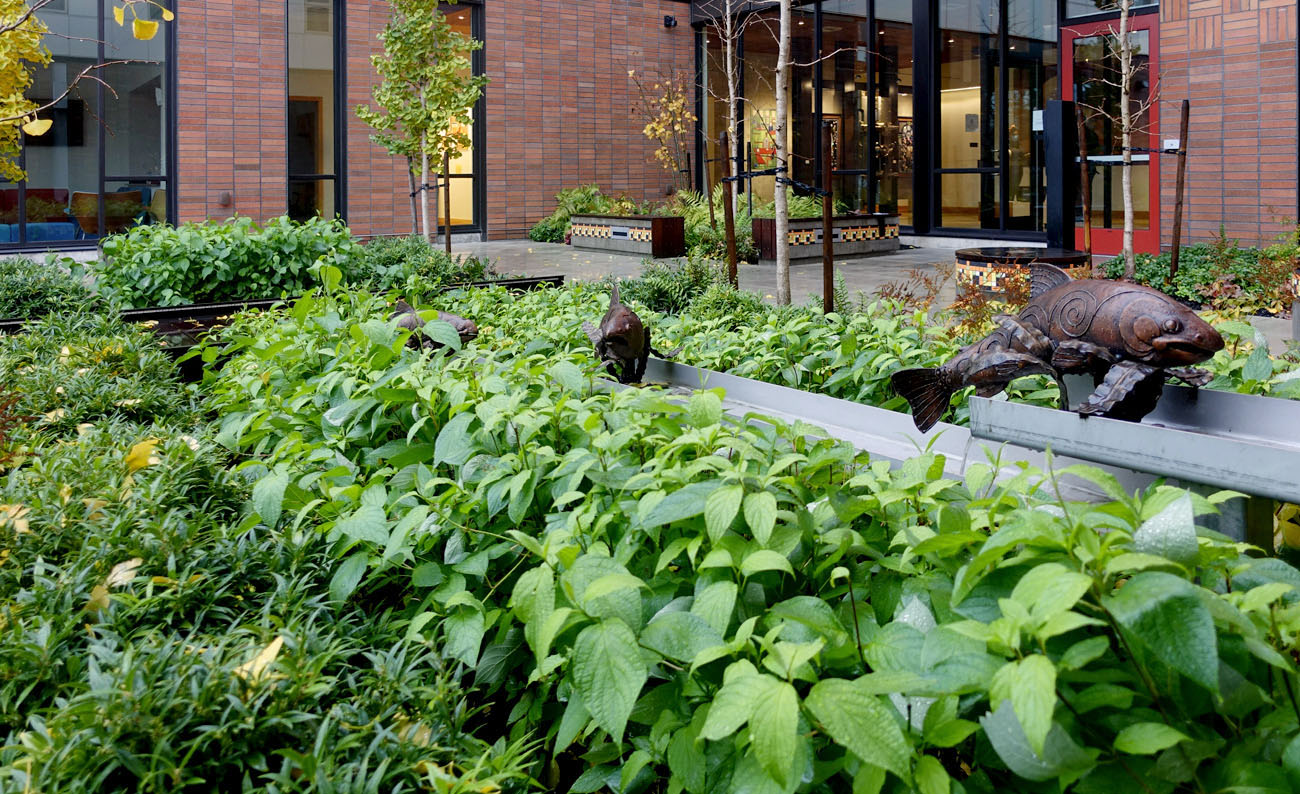
This welcoming entrance courtyard in the Central District integrates stormwater from the roof with an art installation of three bronze salmon called “Struggle Against the Current” by artist Esther Ervin. Her work is also referencing nearby artwork, “Fountains of Triumph” by James Washington, Sr.
Equally important is the cultural shift underpinning this work. As noted by Seattle Public Utilities leadership, the move toward green infrastructure reflects a willingness to trust natural systems and embrace a more adaptive, iterative approach to design. Mithun’s work embodies this philosophy. Rather than assuming solutions, our team emphasizes learning from ecological processes and lived experiences of residents, testing ideas through implementation and refining them over time. This mindset is essential in advancing GSI from experimental pilot projects to a mainstream component of urban infrastructure.
Looking ahead, the lessons from Seattle are highly relevant to other cities facing increasing stormwater challenges due to climate change and urbanization. More intense rainfall events, aging infrastructure and environmental degradation demand new approaches that are both effective and adaptable. Green stormwater infrastructure offers a proven pathway forward.
In Seattle, the goal of managing 700 million gallons annually is not an endpoint but a milestone in an ongoing journey. The city’s innovative approach to water management continues to evolve with programs that include workforce development and partnerships models to design, finance, operate and maintain green infrastructure. Mithun sees growing relationships of this work to climate resilience and restoration of shorelines, biodiversity performance and circular, local economies — highlighting the importance of design leadership in translating ambitious goals into built reality. By bridging disciplines, co-designing with communities and pushing the boundaries of how infrastructure can be designed and implemented, Mithun has helped Seattle redefine the opportunities for how a city lives with water.